Social media for chiropractors: what to post without sounding like every other practice.
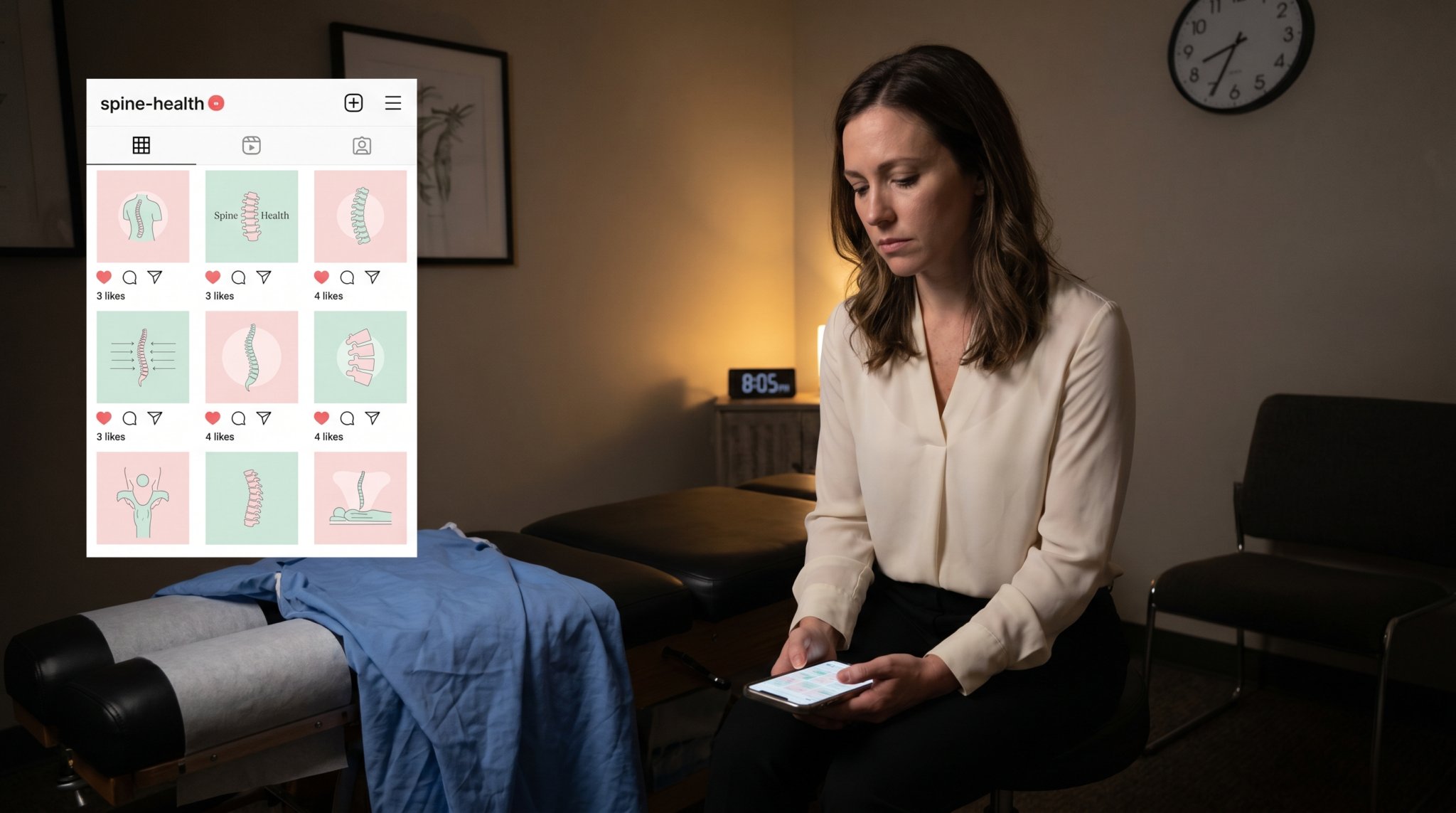
Most chiropractor accounts in San Diego look identical. Pastel infographic. Stock photo of a treatment table that isn’t yours. A quote card about health that has nothing to do with chiropractic. Here’s why that fails the test patients actually run on you. And what to do instead.
A patient with back pain at 9 PM is not choosing a chiropractor with a spreadsheet. They are choosing the one whose social account makes them feel like they are looking at a real practice. Most chiropractor accounts in San Diego do not pass that test.
You’ll see the same thing every time. A pastel “Top 10 Reasons to See a Chiropractor” graphic. A stock photo of a smiling patient on a treatment table that’s clearly not the patient or the table. A quote card with a Mark Twain line about health that has nothing to do with chiropractic. Maybe a “Happy Friday” post with a coffee cup.
This is the chiropractor Instagram playbook. Almost every practice runs it. Almost no patient remembers it the next morning.
If you’re a chiropractor reading this and you’ve been told “just post consistently, the algorithm rewards consistency,” that advice is true and useless at the same time. Posting consistently to a feed that looks like every other practice is consistent invisibility. The algorithm rewards consistent CONTENT, not consistent activity.
Here’s what actually works for chiropractors on social media in 2026, what doesn’t, and why the gap between the two is bigger than most owners realize.
Why most chiropractor Instagram accounts look the same.
It’s not laziness. It’s a workflow problem.
Most chiropractors who try to handle their own social do one of three things. They hire a marketing agency that hands them stock-photo posts about subluxations. They use a Canva template they bought from a chiropractic-specific marketing course. They open ChatGPT, type “write me 10 Instagram posts about chiropractic care,” and post whatever comes out.
All three workflows produce the same result: content that’s about chiropractic in general, not about you.
A patient looking at your feed doesn’t decide based on accurate spinal information. They decide based on whether you feel like a real person they can trust with their body. Generic content fails that test. It tells the patient nothing about your hands, your manner, your office, your beliefs about pain management, or whether you’re the kind of doctor who’ll listen for the first 15 minutes before adjusting them.
The fix isn’t more content. It’s content that’s actually about you.
What actually works for chiropractors on social.
Five categories, in priority order.
1. Patient transformation stories, with permission. A 58-year-old plumber walked in unable to lift his right arm. After six visits, he picked up his grandson for the first time in two years. He gave you a video testimonial. Post it. Add 30 seconds of you explaining what you actually did, in plain language, no jargon. This single post will outperform six months of generic posts because it answers the only question new patients silently ask: “Will this work for someone like me?”
2. Founder POV, in your actual voice. A 60-second video of you in your office talking about what you wish patients understood before their first visit. Not a script. Not a brand voice. Your actual voice. The way you’d talk to a friend at dinner who asked what you do. People follow people, not practices. Your face shows up 8-12 times in your last 30 posts and the conversion math changes.
3. Common-objection content. Every chiropractor knows the questions patients ask before booking. Does it hurt. How long until I feel a difference. Will I have to come back forever. Is it safe during pregnancy. Can it help my migraines. Make a post for each one. Plain answer, your voice, no fluff. These are the search queries patients are typing into Google. If your post answers them, it shows up in search AND in their feed.
4. Behind-the-scenes, HIPAA-compliant. You setting up a treatment table in the morning. You talking through your day. Your office dog. Your team prep meeting. A view of San Diego out your window. None of these reveal patient information. All of them make you feel like a real practice with real humans.
5. Local SEO content. “Best chiropractor for runners in Pacific Beach.” “What to expect at your first visit if you’ve never seen a chiropractor in San Diego.” “How chiropractic differs from physical therapy.” These posts double as SEO content because they target real searches. Every one of them increases the chance someone in your zip code finds you.
What’s missing from this list: stock photos, generic infographics, motivational quotes, holiday-themed posts that don’t connect to chiropractic, and AI-generated explainers about subluxation. None of those move the needle. All of them feel safe. That’s why everyone runs them.
The 5-post-a-week structure that doesn’t burn you out.
Most chiropractors fail at social not because they don’t know what to post. They fail because they try to post daily, run out of ideas by week two, and quit.
Five posts a week beats seven, posted for one month and abandoned. Here’s a structure that’s sustainable for a solo practice:
- Monday: Educational. A common-objection post. 60 seconds of you, in your voice, answering one question.
- Tuesday: Founder POV. A behind-the-scenes moment from your morning. Phone camera. No edit.
- Wednesday: Patient story. With permission, recorded once a month, released weekly.
- Thursday: Local content. Something tied to your city, neighborhood, a local event, a local question.
- Friday: Light personality. Office dog. Team. Lunch. Something human.
That’s five posts. Each takes 5-15 minutes to produce if you batch on a Sunday. The whole week’s content is queued by Sunday night.
If five posts a week feels like a lot, three posts a week, run for 12 months, beats seven posts a week run for two months. The compounding is in the consistency, not the volume.
The tools most chiropractors use wrong.
Three tools dominate the chiropractor social media stack. Each is misused in a specific way.
ChatGPT, used as a one-shot caption generator. You ask it to write 10 Instagram posts. It produces 10 posts that sound like every other practice’s posts because it’s trained on every other practice’s posts. The output is the average, and average doesn’t stand out. ChatGPT becomes useful only when you’ve fed it 30 minutes of your own voice first. Without that, it homogenizes you.
Canva, used to recreate the Pinterest aesthetic. Pastel backgrounds. Sans-serif fonts. Inspirational quotes. Every chiropractor’s feed using the same Canva templates means every chiropractor’s feed looks like every other chiropractor’s feed. If you use Canva, customize it heavily or skip the template-driven approach. Phone-camera content beats well-designed-but-generic graphics in 2026.
Schedule-and-forget tools, used to batch a year of posts in one weekend. Auto-scheduling 100 posts and walking away creates a “ghost feed” that looks active but never engages. Comments go unanswered. Trends pass without acknowledgment. The algorithm penalizes accounts that post but don’t show up in comments. Schedule, but check in daily for 5 minutes.
When to DIY vs. outsource.
Most chiropractors should not handle their own social. Here’s the honest math.
Producing 5 posts a week well, including the patient stories and founder videos, takes a chiropractor 4-6 hours per week if they’re efficient. Most chiropractors charge between $80-$200 for a typical visit. Five hours of social media production is the equivalent of 3-7 patient visits, every week, every month, forever.
The right question isn’t “can I do this myself.” It’s “is the marginal patient I’d see in those 5 hours worth more than the marginal patient social media will eventually generate.”
For most practices doing $300K-$2M in revenue, the answer is no. Outsource the production. Keep the strategy and the founder POV pieces. Pay someone else to handle the photography, the editing, the scheduling, the captions, and the comment management.
What to look for in a partner:
- Real voice capture. They should spend 60+ minutes with you up front to capture how you actually talk. If they jump straight to “what’s your color palette,” walk away.
- Niche understanding. They don’t have to be chiropractor specialists, but they should ask about HIPAA, scope-of-practice, advertising rules in your state, and whether you can show patient photos.
- A real product, not a Google Doc. A monthly Google Doc full of post drafts that you have to remember to copy, paste, and schedule is the same friction as doing it yourself. The right partner gives you a content board on your phone where you can copy-and-post in 11 minutes a week.
- Money-back proof, not promises. Anyone who promises a number of new patients is lying. Anyone who guarantees their content will sound like you, with a money-back guarantee, is staking their reputation on the only thing they can actually control.
The real reason most chiropractor social fails.
It’s not creativity. It’s not budget. It’s not the algorithm.
It’s that producing original content about yourself, every week, is psychologically expensive. Writing your own Instagram captions means deciding what to say about your own work. That’s vulnerable. Most chiropractors fall back on stock content because stock content lets them avoid the vulnerability of actually being seen.
The fix is not “post more.” The fix is “post YOU more.”
Whether you do that yourself or hire someone to do it for you, the principle is the same. Your patients want to feel like they know you before they book. Generic content fails that test. Your content, in your voice, with your face occasionally visible, passes it.
Common questions.
How often should a chiropractor post on Instagram?
Three to five posts per week, run consistently for 12 months. The volume matters less than the cadence. Three posts a week for a year beats seven posts a week for two months. Algorithms reward consistency over time, not bursts of activity.
What hashtags work for chiropractors?
Local hashtags outperform niche hashtags for most practices. #SanDiegoChiropractor will reach more potential patients than #SubluxationSpecialist. Use 5-10 hashtags per post, mix two or three local-geographic ones, two or three niche-specific ones (chiropractor, spinaladjustment), and two or three audience-specific ones (runner, prenatal, autoaccident). Avoid hashtag dumps of 30+ which Instagram has been deprioritizing since 2023.
Can chiropractors post patient photos on social media?
Only with written, signed HIPAA-compliant consent that specifically authorizes social media use. Verbal permission is not enough. Even with consent, avoid posting anything that could be used to identify the patient beyond what they’ve authorized (full name, location, exact treatment details). When in doubt, post anonymized stories or video testimonials where the patient narrates their own experience.
What’s the best social media platform for chiropractors?
Instagram and Facebook for most practices, in that order. Instagram for younger demographics and visual content, Facebook for older patients and local community engagement. TikTok works for chiropractors comfortable with short-form video and a younger audience. LinkedIn is mostly wasted effort for chiropractors unless you’re targeting corporate wellness contracts. YouTube works long-term for educational content but takes 12+ months to compound.
How much does social media management cost for a chiropractor?
Done-for-you services for a single-location chiropractic practice typically run between $800 and $3,000 per month, depending on volume and quality. The cheaper end produces generic content. The mid-tier ($1,500-$2,000) produces practice-specific content with monthly strategy calls. Custom-quoted enterprise tiers exist but rarely make sense for solo practices. Be wary of anyone charging less than $800 per month. At that price, the quality drops below “would have been better to skip social entirely.”
Content that actually sounds like you, every month.
30 polished pieces every month, image attached, in your voice, sitting in a board on your phone. Pick, copy, post. Eleven minutes a week.